Yesterday, Tabular Editor 3 shipped a new feature called Semantic Bridge. It is still very much an MVP, but I honestly believe it is one of the most important additions we’ve seen in the Fabric + Databricks story so far.
For a while now, Microsoft, Databricks, and many peers in the community have been telling a consistent “Better together” story. We already have strong integrations: OneLake, Delta Sharing, and the ability to mirror Databricks Unity Catalog objects into Fabric. These are all meaningful steps toward openness and interoperability.
But one critical piece has been missing.
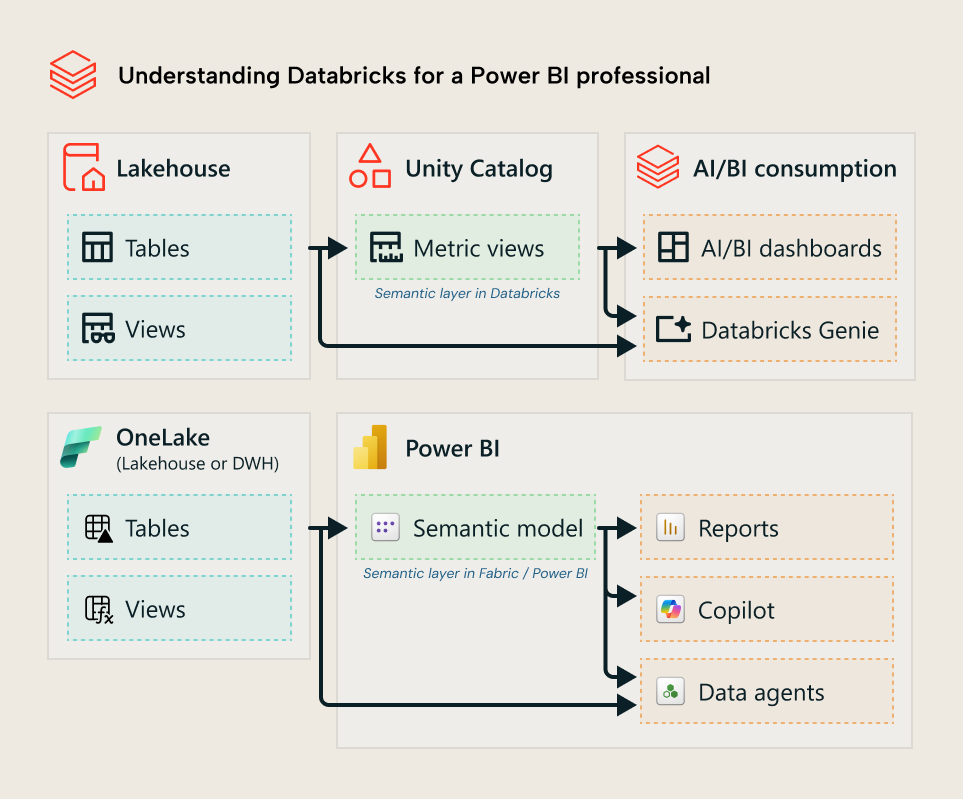
Metric Views as the semantic layer in Databricks
Databricks Metric Views are designed to be the single place where business metrics are defined, governed, and reused. That aligns perfectly with what BI developers have always tried to achieve: define metrics once, in one place, and reuse them everywhere. Metric Views also unlock value in Databricks-native experiences like AI/BI Dashboards and AI/BI Genie.
Yet in reality, that is often not enough. Many organizations still rely on Power BI as their primary BI frontend. It has been the de facto standard for close to a decade, and for good reasons: semantic modeling depth, visualization flexibility, distribution, and governance.
Until now, there has been no real integration path between Databricks Metric Views and Power BI.
Enter Semantic Bridge
This is where Semantic Bridge changes the game.
Semantic Bridge allows you to bring Databricks Metric Views into Tabular Editor and project them into a Power BI semantic model. The metric definitions stay in Databricks, where they belong, while Power BI gains access to those standardized metrics through a proper semantic layer. You get consistency across platforms without duplicating logic or redefining business rules.
That, to me, is the key point: this is not about replacing one tool with another. It is about letting each platform do what it does best, while sharing semantics instead of fragmenting them.
A small personal note
On a more personal note, I am especially happy to see this feature come to life. Long before I joined Tabular Editor, I had a small role in sparking the initial conversation between Søren Joensen and Simon Whiteley from Advancing Analytics at SQLBits London in June 2025. Both are good friends, and it turns out that good things happen when curious people start exploring ideas together.
What comes next
A big shoutout also goes to Greg Baldini, who is the main developer behind Semantic Bridge. This first release is only the beginning. Greg and the rest of the Tabular Editor team have ambitious plans for extending the bridge with more capabilities, deeper integrations, and richer workflows.
Semantic Bridge is not “done”. But it is a clear signal of where things are heading: fewer duplicated metrics, clearer ownership of business logic, and a much stronger Fabric + Databricks story for organizations that rely on both.
If this is the direction you’ve been hoping for, now is a great time to start paying attention.